Archon: AI Code Reviewer
A stateless, context-aware auditor leveraging Gemini 1.5 Pro to detect architectural violations, O(n²) performance bottlenecks, and security flaws in distributed systems.
Beyond the Linter: Building a Context-Aware AI Architecture Reviewer
Most AI code review tools today suffer from a "tunnel vision" problem. They look at a single pull request diff in isolation, nitpicking variable names or formatting while completely missing the forest for the trees.
I decided to build something different: an AI Architecture Reviewer that understands the "map" of your codebase.
The Problem: AI with Tunnel Vision
Standard LLM-based code reviewers often function like high-powered linters. They are great at finding a missing null check, but they have no idea if your new OrderController is illegally bypassing the OrderService to query the database directly.
To catch architectural violations, an AI needs context. It needs to know what the rest of the project looks like.
The Solution: A Hybrid Context Engine
My tool uses a stateless, hybrid approach to review code. It doesn't just send a diff to an LLM; it builds a temporary "Context Layer" on the fly.
1. Context-Awareness (The USP)
Before the AI begins its review, the backend fetches the entire repository file tree. By feeding this structure into Gemini 1.5 Pro’s massive context window, the AI gains a "birds-eye view" of the project. It understands:
- The Architecture Style: Is it a monolith or microservices?
- Layer Boundaries: Does the project follow a Clean Architecture or Hexagonal pattern?
- Framework Idioms: Is it using Spring Boot, Next.js, or FastAPI correctly?
2. The Performance Audit (Big O & Beyond)
We didn't stop at architecture. The tool is programmed with a specialized performance heuristics checklist. It looks for:
- N+1 Queries: Detecting loops that hide database calls.
- Complexity Analysis: Identifying or higher complexities and explaining the impact using Big O notation.
- Memory Pressure: Finding large object allocations without pagination.
Technical Deep Dive
I built this using a modern, high-performance stack designed for speed and privacy.
- Backend: FastAPI (Python). Chosen for its native asynchronous support and strict type-safety with Pydantic.
- Frontend: Next.js 14. A sleek dashboard that renders real-time suggestions with custom diff viewers.
- AI Engine: Gemini 1.5 Pro. Utilized for its 2-million token context window, allowing us to pass entire repository maps without losing "focus."
- Privacy-First: The tool is Stateless. It uses a "Bring Your Own Token" (BYOT) model. No code is stored, no tokens are saved, and the memory is wiped the moment the analysis is complete.
Explainability: Building Trust with Developers
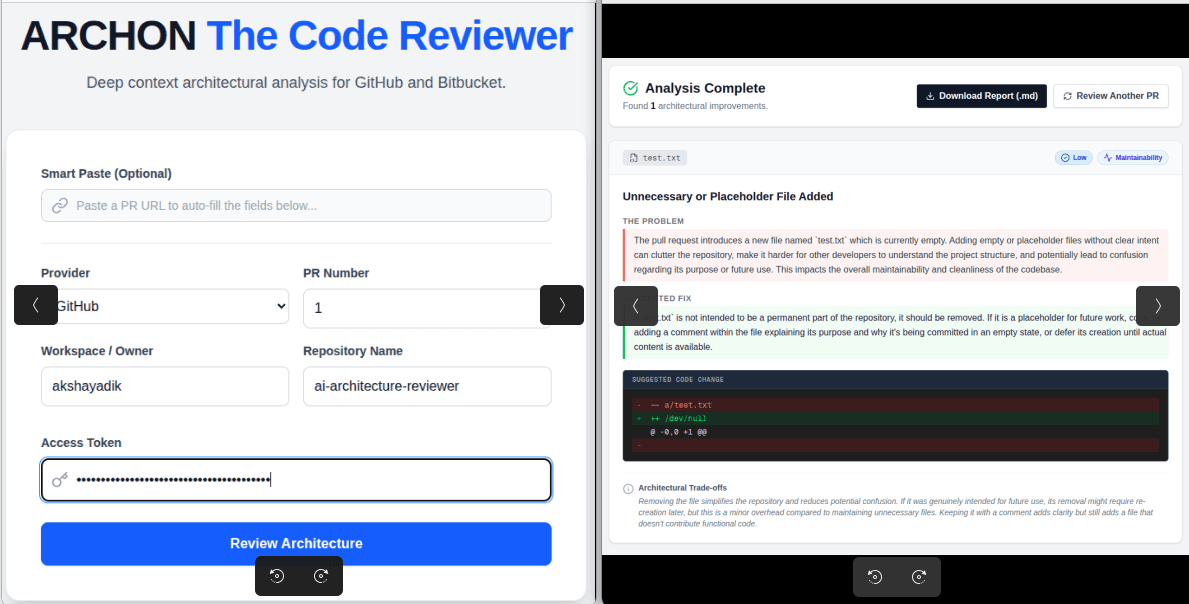
A tool is only as good as its suggestions. I designed the UI to focus on Explainability. Every issue found by the AI is broken down into four parts:
- The Problem: Why exactly is this code problematic?
- The Fix: A clear, actionable suggestion.
- The Diff: A visual before-and-after representation.
- The Trade-offs: An honest look at the architectural cost of the change.
Lessons Learned
Building this taught me that the "Context Window" is the most undervalued asset in AI development. By moving away from "RAG" (Retrieval-Augmented Generation) and toward "Long-Context In-Memory Injection," we can achieve architectural insights that were previously impossible for machines to catch.