AI Architecture Reviewer
Automated audit tool for distributed systems.
8 min•advanced
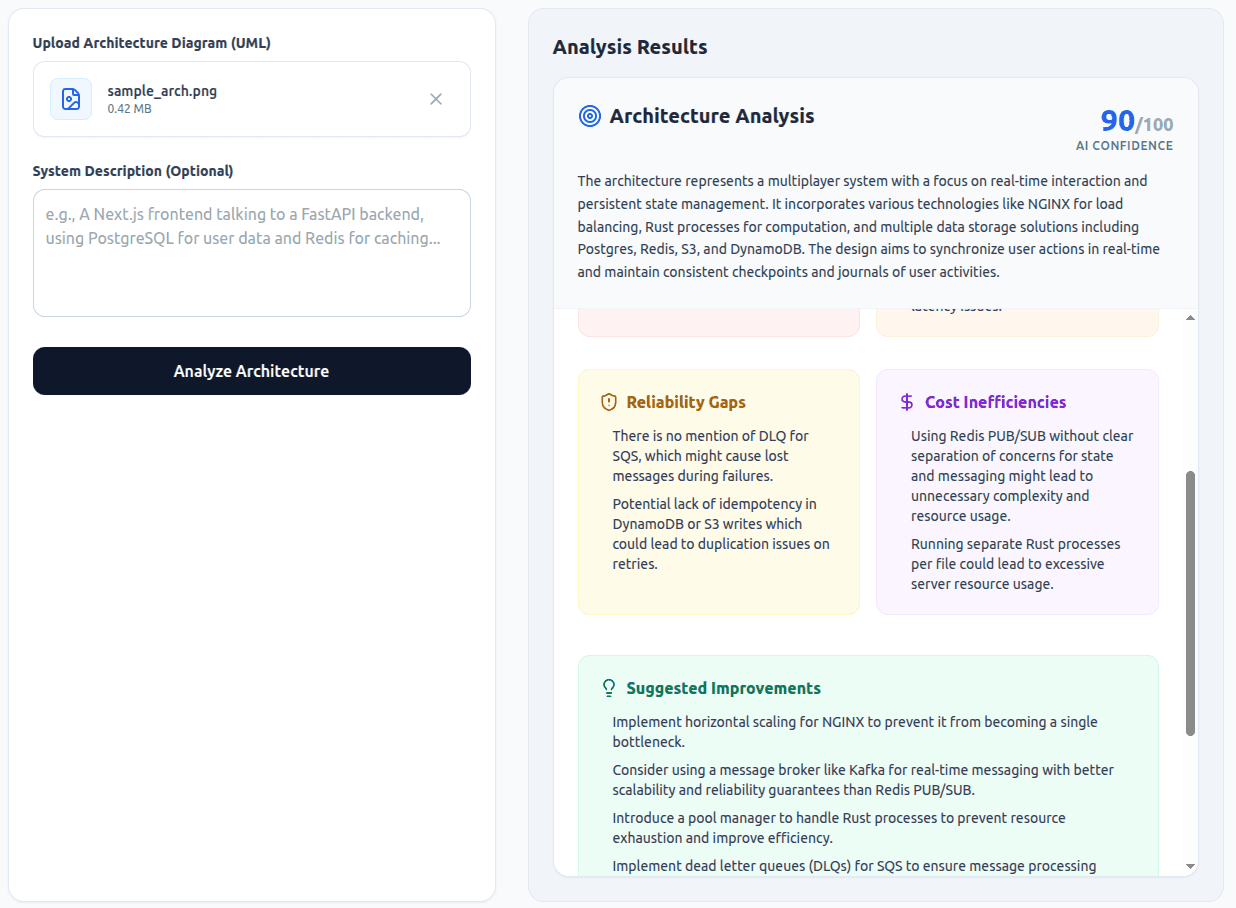
Case Study: AI Architecture Reviewer
Strategic AI for System Design & Consultancy
1. Problem Framing
In high-growth engineering environments, architectural reviews are a critical but manual bottleneck. Senior engineers spend significant time identifying recurring anti-patterns in system designs, which can delay development cycles by days or weeks.
The AI Architecture Reviewer was built to:
- Scale Expertise: Provide instant, high-fidelity feedback that traditionally requires a Staff Engineer's review.
- Ensure Consistency: Ground AI critiques in verified industry best practices rather than generic LLM hallucinations.
- Enable Multi-modal Intake: Support engineers who think in both diagrams (UML) and prose.
2. What This System Does
The platform acts as an automated design partner. A user uploads a system diagram (PNG/JPG) or provides a text description of their stack. The system then:
- Visually Parses the Design: Extracts components and data flows from images.
- Retrieves Context: Queries a vector database for relevant architectural patterns.
- Generates Structured Critiques: Produces a categorized report covering bottlenecks, scalability, reliability, and cost.
3. System Architecture
The following diagram illustrates the request flow from the Next.js frontend to the RAG-enabled FastAPI backend.
graph TD
    subgraph "Frontend (Vercel)"
        A[Next.js UI] --> B[API Client]
    end

    subgraph "Backend (Render)"
        B --> C[FastAPI Router]

        subgraph "AI Router"
            C --> D{Input Type?}
            D -- Image --> E[GPT-4o Vision Parser]
            D -- Text --> F[Text Normalizer]
            E --> F
        end

        subgraph "RAG Layer"
            F --> G[OpenAI Embeddings]
            G --> H[(ChromaDB)]
            H --> I[Context Retrieval]
        end

        subgraph "LLM Integration"
            I --> J[GPT-4o Structured Output]
            F --> J
            J --> K[Pydantic Validation]
        end
    end

    K --> L[Next.js Critique Cards]
Architecture Components:
- Frontend (Next.js): Hosted on Vercel, utilizing Tailwind CSS for a responsive dashboard and Lucide React for status iconography.
- Backend (FastAPI): Hosted on Render, managing multipart/form-data for image processing and handling asynchronous AI streams.
- AI Router: Directs inputs to the GPT-4o Vision API to transform visual UML diagrams into objective system summaries.
- RAG Layer: A persistent ChromaDB instance seeded with patterns such as Event-Driven Architecture, ML Serving, and Data Warehousing.
- LLM Integration: Utilizes OpenAI's Structured Outputs to guarantee the API returns a validated JSON schema.
4. Real-Time Capabilities
- Instant Vision Parsing: Real-time conversion of Base64-encoded images into architectural text.
- Dynamic UI Updates: A state-driven React frontend that provides immediate feedback during the "Consulting best practices" phase.
- On-the-Fly Database Seeding: The system detects an empty vector store on deployment and automatically populates it with engineering patterns.
5. Observability
- Structured Logging: Backend logs track the flow from image extraction to RAG retrieval and final LLM response.
- Confidence Scoring: Every critique includes a confidence score (1–100) based on the clarity of the input and the relevance of the retrieved data.
- AI Reasoning Trace: The UI displays the "AI Reasoning" behind every score, providing transparency into how the critique was formulated.
6. Limitations
- Ephemeral Storage: On free-tier hosting (Render), the local ChromaDB storage resets during server restarts, necessitating a re-seed of data.
- Diagram Complexity: Extremely dense or non-standard UML diagrams may require supplemental text descriptions for 100% accuracy.
- Cold Starts: Initial requests after inactivity may experience latency as the backend service wakes up.
7. Roadmap
- Cloud Vector Database: Migrate from local ChromaDB to a managed instance (e.g., Pinecone or MongoDB Atlas) for permanent persistence.
- Custom Knowledge Uploads: Allow consultancy clients to upload their own internal architecture "Gold Standards" to the RAG layer.
- Multi-Agent Collaborative Review: Implement a "Debate" mode where two AI agents (e.g., a "Security Architect" and a "Cost Optimizer") critique the design simultaneously.